“Decorative” morphology in Spanish : at the crossroads of typology and sociolinguistics
Benítez-Burraco, Antonio ; Marqueta Gracia, Bárbara (Universidad de Zaragoza)
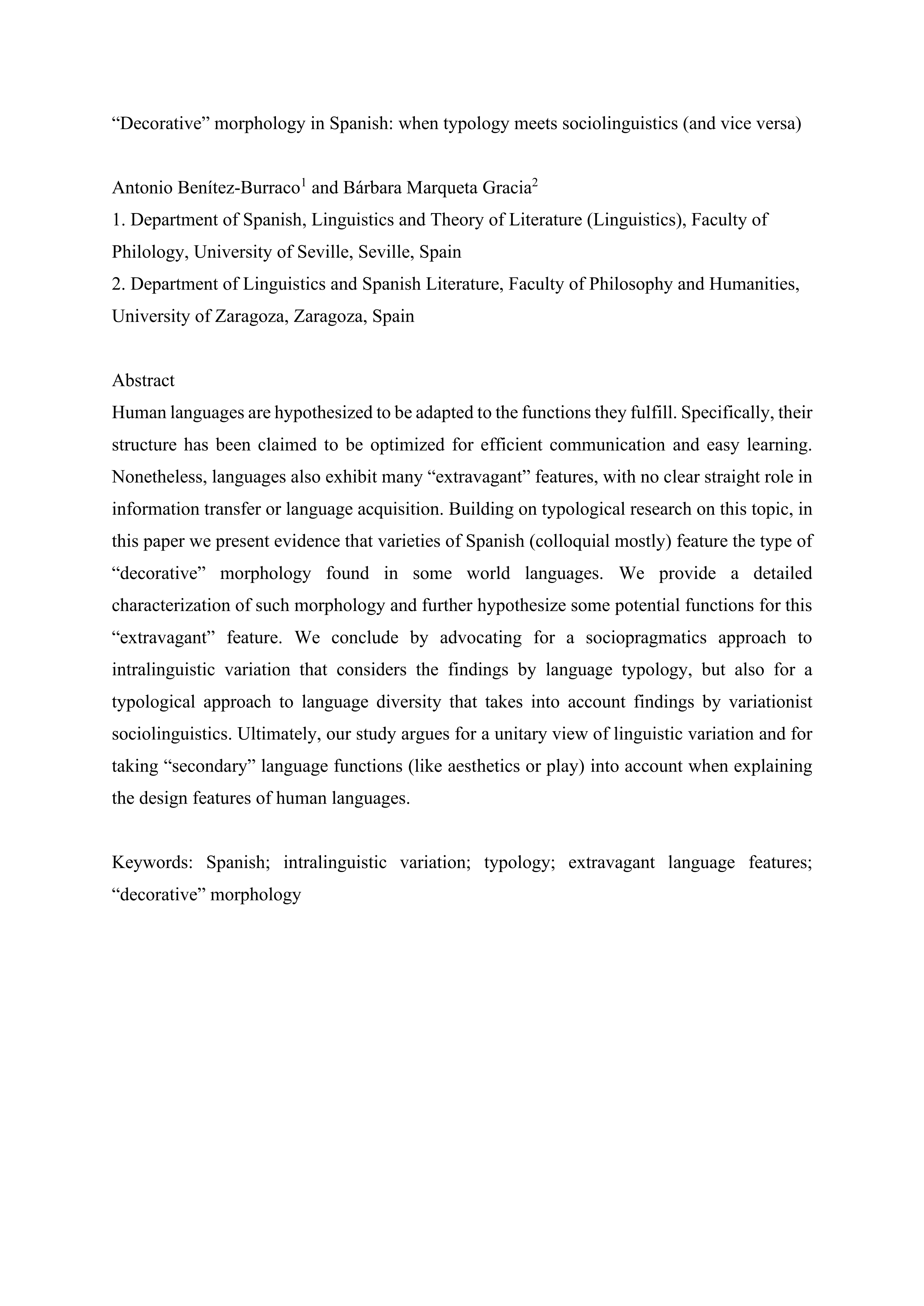
Resumen: Human languages are hypothesized to be adapted to the functions they fulfill. Specifically, their structure has been claimed to be optimized for efficient communication and easy learning. Nonetheless, languages also exhibit many “extravagant” features, with no clear role in information transfer or language acquisition. Building on typological research on this topic, in this paper we present evidence that varieties of Spanish (colloquial mostly) feature the type of “decorative” morphology found in some world languages. We provide a detailed characterization of such morphology and further hypothesize some potential functions for it. We conclude by advocating for a sociopragmatics approach to intralinguistic variation that also considers the findings by language typology, but likewise for a typological approach to language diversity that pays attention to the findings by variationist sociolinguistics. Ultimately, our study argues for a unitary view of linguistic variation and for considering functions like aesthetics or play when explaining the design features of language.
Idioma: Inglés
DOI: 10.1075/sic.25010.ben
Año: 2025
Publicado en: SPANISH IN CONTEXT (2025), [22 pp.]
ISSN: 1571-0718
Tipo y forma: Article (PostPrint)
Área (Departamento): Área Lengua Española (Dpto. Lingüíst.y Liter.Hispán.)
0
Exportado de SIDERAL (2025-11-27-15:16:28)
Idioma: Inglés
DOI: 10.1075/sic.25010.ben
Año: 2025
Publicado en: SPANISH IN CONTEXT (2025), [22 pp.]
ISSN: 1571-0718
Tipo y forma: Article (PostPrint)
Área (Departamento): Área Lengua Española (Dpto. Lingüíst.y Liter.Hispán.)
0
Exportado de SIDERAL (2025-11-27-15:16:28)
Este artículo se encuentra en las siguientes colecciones:
articulos > articulos-por-area > lengua_espanola
Notice créée le 2025-11-27, modifiée le 2025-11-27
 Postprint
 Postprint