Prediction of cardiovascular risk using machine-learning methods. Sex-specific differences
Castel-Feced, Sara (Universidad de Zaragoza) ; Aguilar-Palacio, Isabel (Universidad de Zaragoza) ; Malo, Sara (Universidad de Zaragoza) ; González-García, Juan ; Maldonado, Lina (Universidad de Zaragoza) ; Rabanaque-Hernández, María José (Universidad de Zaragoza)
Resumen: Machine learning (ML) algorithms offer some advantages over traditional scoring systems to assess the influence of cardiovascular risk factors (CVRFs) on the risk of major cardiovascular event (MACE), and could be useful in clinical practice. These algorithms can also be trained using a growing body of real world data (RWD). The aim of the study was to evaluate the MACE risk applying the XGBoost and Random Forest ML algorithms to RWD, stratifying the study population by sex, comparing the outcomes of these two algorithms.MethodsThe follow-up period of the study was from 2018 to 2020. For each algorithm, 3 models were generated, including age and different combinations of three groups of variables: blood test and blood pressure measurements; CVRFs; and medication adherence.ResultsIn this study, 52,393 subjects were included, of whom 581 suffered a MACE. The incidence of MACE was 1% in women and 1.3% in men. The most prevalent CVRF was hypertension, followed by hypercholesterolaemia in both sexes. Adherence to treatment was highest for antihypertensives and lowest for antidiabetics. In all models age was the greatest relative contributor to the risk of MACE, followed by adherence to antidiabetics. Adherence to treatment proved to be an important variable in the risk of having a MACE. Moreover, similar performance was found for RF and XGBoost algorithms.ConclusionThese findings support the use of ML to assess cardiovascular risk and guide personalized prevention strategies in primary care settings.
Idioma: Inglés
DOI: 10.3389/fcvm.2025.1579947
Año: 2025
Publicado en: Frontiers in cardiovascular medicine 12 (2025), 1579947 [11 pp.]
ISSN: 2297-055X
Financiación: info:eu-repo/grantAgreement/ES/DGA-GRISSA/B09-23R
Financiación: info:eu-repo/grantAgreement/ES/DGA-IIU/796-2019
Financiación: info:eu-repo/grantAgreement/ES/ISCIII/PI22-01193
Tipo y forma: Article (Published version)
Área (Departamento): Área Estadís. Investig. Opera. (Dpto. Métodos Estadísticos)
Área (Departamento): Área Métodos Cuant.Econ.Empres (Dpto. Economía Aplicada)
Área (Departamento): Área Medic.Prevent.Salud Públ. (Dpto. Microb.Ped.Radio.Sal.Pú.)
0
Exportado de SIDERAL (2025-10-17-14:37:46)
Idioma: Inglés
DOI: 10.3389/fcvm.2025.1579947
Año: 2025
Publicado en: Frontiers in cardiovascular medicine 12 (2025), 1579947 [11 pp.]
ISSN: 2297-055X
Financiación: info:eu-repo/grantAgreement/ES/DGA-GRISSA/B09-23R
Financiación: info:eu-repo/grantAgreement/ES/DGA-IIU/796-2019
Financiación: info:eu-repo/grantAgreement/ES/ISCIII/PI22-01193
Tipo y forma: Article (Published version)
Área (Departamento): Área Estadís. Investig. Opera. (Dpto. Métodos Estadísticos)
Área (Departamento): Área Métodos Cuant.Econ.Empres (Dpto. Economía Aplicada)
Área (Departamento): Área Medic.Prevent.Salud Públ. (Dpto. Microb.Ped.Radio.Sal.Pú.)
0
Exportado de SIDERAL (2025-10-17-14:37:46)
Este artículo se encuentra en las siguientes colecciones:
articulos > articulos-por-area > metodos_cuantitativos_para_la_economiay_la_empresa
articulos > articulos-por-area > estadistica_e_investigacion_operativa
articulos > articulos-por-area > medicina_preventiva_y_salud_publica
Notice créée le 2025-07-22, modifiée le 2025-10-17
Liens externes:
 Versión publicada
Versión publicada
Versión publicada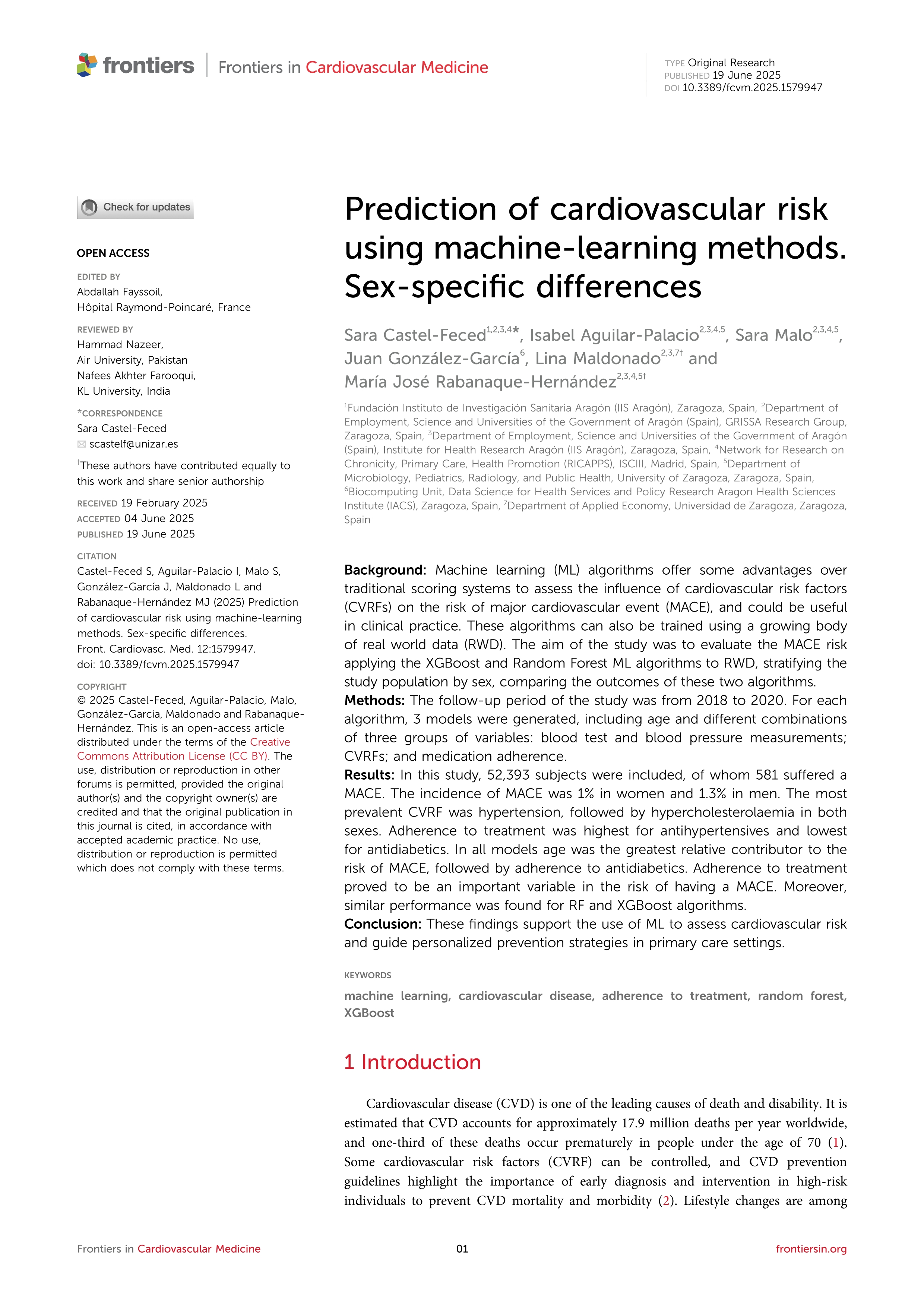 Versión publicada